
By RIOD Engineering · May 29, 2026
Depot Charging Load Management: More Chargers Than Your Sanctioned Load Should Allow
A 500 kW sanctioned depot can only run five 100 kW DC chargers at full power at once (fewer, after you reserve headroom for the rest of the depot's load). It can run ten to twelve if the load management is smart. That's a 2-3x fleet expansion without upgrading the grid connection.
Here's how dynamic load management works, and why every serious fleet depot ships with it now.
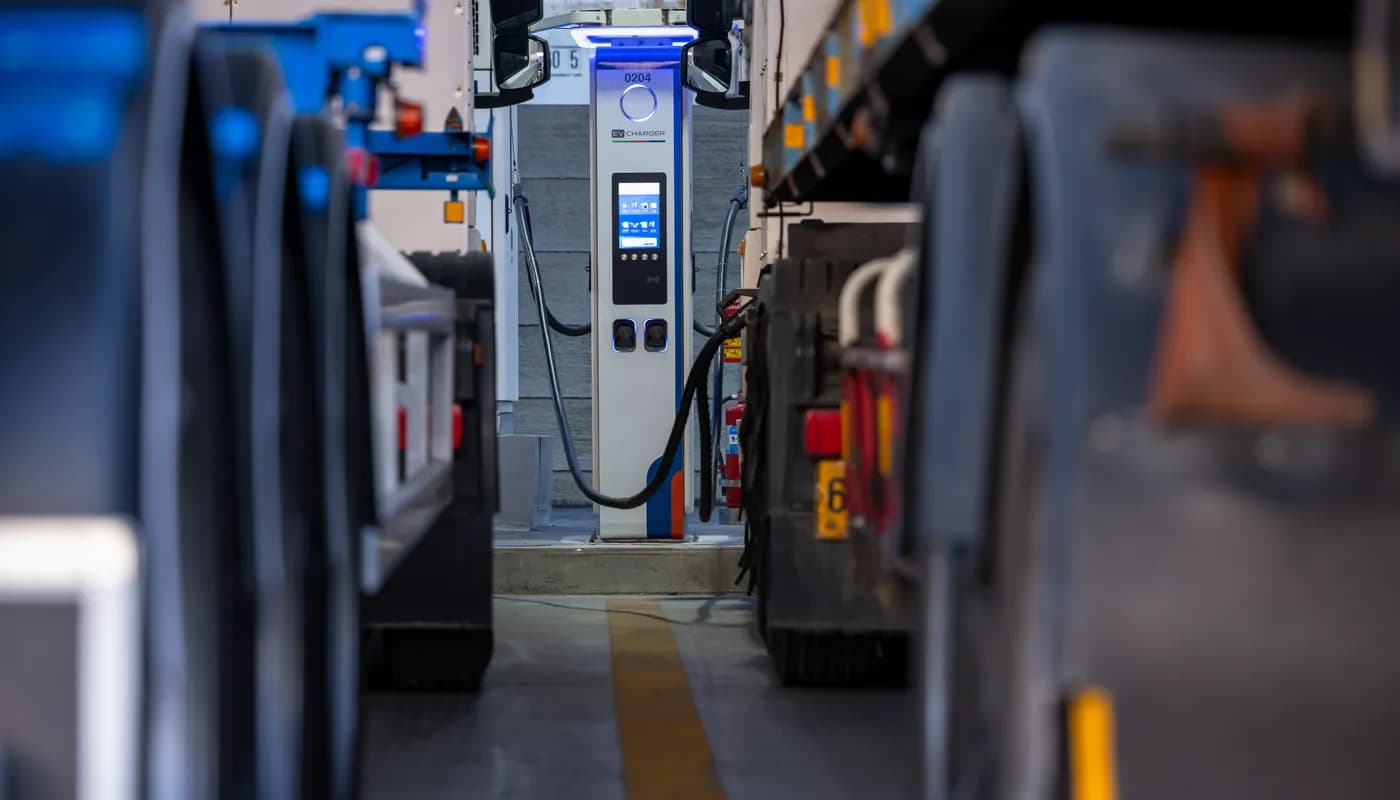
The sanctioned demand problem
Indian depots contract a specific kW ceiling with the DISCOM. Exceed it and you pay penalty tariffs; sustained exceedance and your connection can be reduced. The sanctioned load is a hard constraint, not a soft one.
The naive way to respect it is to size the charger fleet so total simultaneous draw never exceeds the sanctioned load. This wastes headroom continuously because peak demand only happens for a few hours; the rest of the time chargers sit idle or slow when they could be faster.
Static vs dynamic load allocation
Static allocation gives every charger a fixed maximum power that sums to sanctioned load. Simple, safe, wasteful. Ten 25 kW chargers on 250 kW sanctioned; each is capped at 25 kW even when eight are idle.
Dynamic allocation redistributes continuously. When four buses are charging, they can each take up to 62.5 kW. When one bus is charging, it can take 250 kW (subject to its own onboard limit). Priority rules ensure the bus closest to departure gets the power it needs first.
Priority rules and phase balancing
Priority scoring composes departure time, SoC deficit, route class and manual overrides. A pull-out at 5am gets power ahead of one at 8am. A bus at 30% SoC gets power ahead of one at 70%. A stated route priority can override both.
Phase balancing keeps three-phase depots inside per-phase current limits, which the transformer cares about even when total power is fine. Good load management engines allocate per-phase, not just per-total.
Scheduler inputs
- Departure time and required SoC per vehicle
- Route length and expected energy draw
- Charger max power and available connectors
- Vehicle max charge acceptance rate
- Depot's live non-charging load
- Time-of-use tariff windows and DISCOM sanctioned demand
Load allocation example
Twelve 30 kW chargers share 500 kW of sanctioned depot power. At 6am, three buses need to pull out by 8am with a 200 km route ahead of them. The scheduler pushes those three chargers to 100 kW each (300 kW total), while the remaining nine chargers rotate through 22 kW each until the priority buses hit target SoC. As those buses come off, headroom is redistributed across the rest of the fleet, and the whole depot stays inside its 500 kW ceiling for the entire window.
Read Our Next Article

Electric Bus and Logistics Fleet Charging in India

Payment Migration for EV Charging Networks: What Gets Missed

The Zero-Downtime CMS Migration Playbook

OCPP Profile Drift: Why “OCPP-Compatible” Isn’t Enough for CMS Migration
Enel X Way Shutdown: The Migration Checklist for CPO Fleets

UPI vs RFID vs App: Charging Payment Methods Compared
Deploying EV charging?
Talk to our team about your project. We design, supply, and manage EV charging infrastructure across India.